Board Settings
Configure your board's appearance, access, language, and roadmap
Your board settings control how visitors see and interact with your public board. Open Settings in your dashboard and stay on the Board tab.
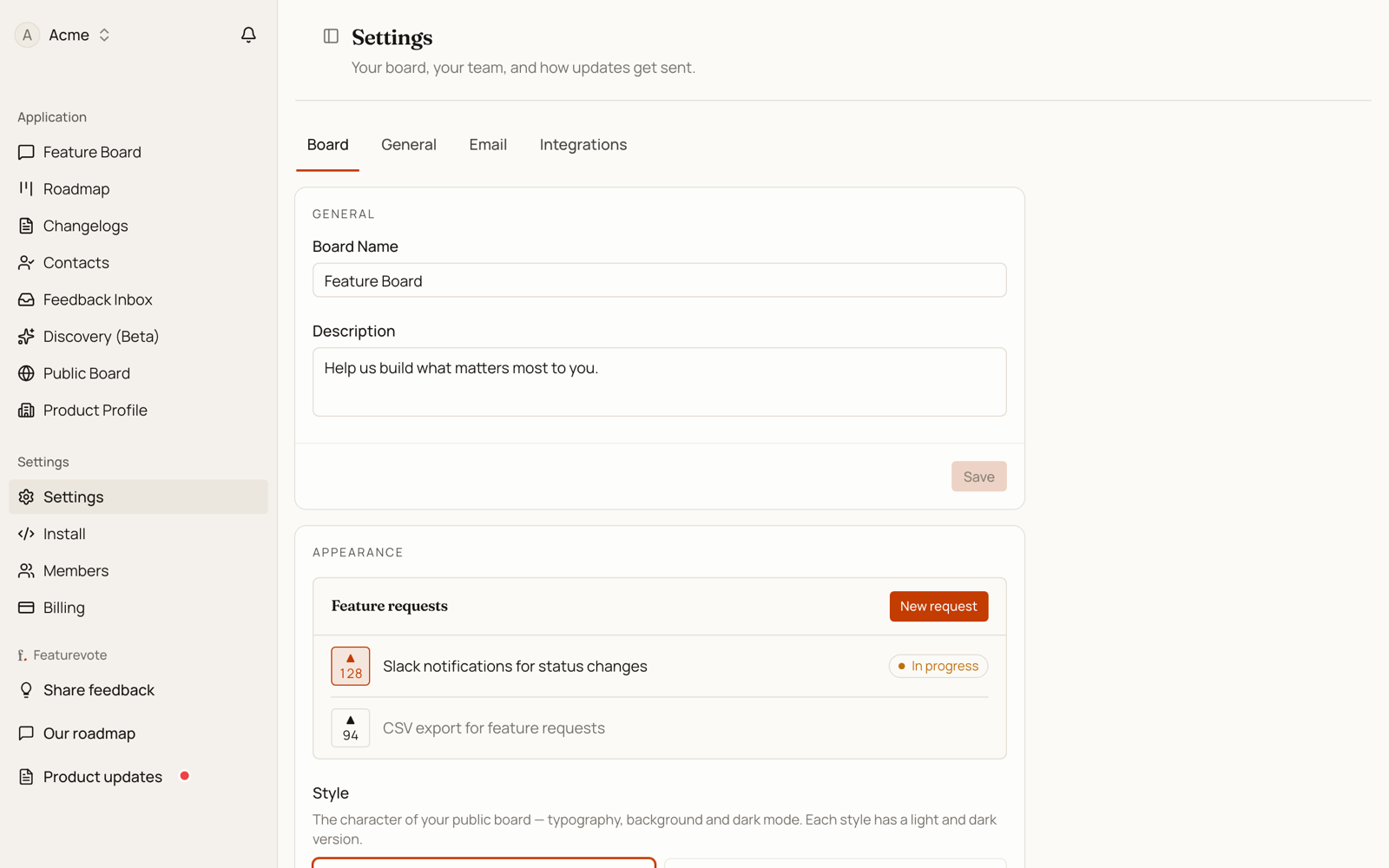
Each section is its own card with its own Save. The button stays greyed out until you actually change something, and an Unsaved changes note appears next to it while an edit is pending — so nothing reaches your public board until you say so.
General
- Board Name — the title shown on your public board.
- Description — a short line under the title explaining what the board is for.
Appearance
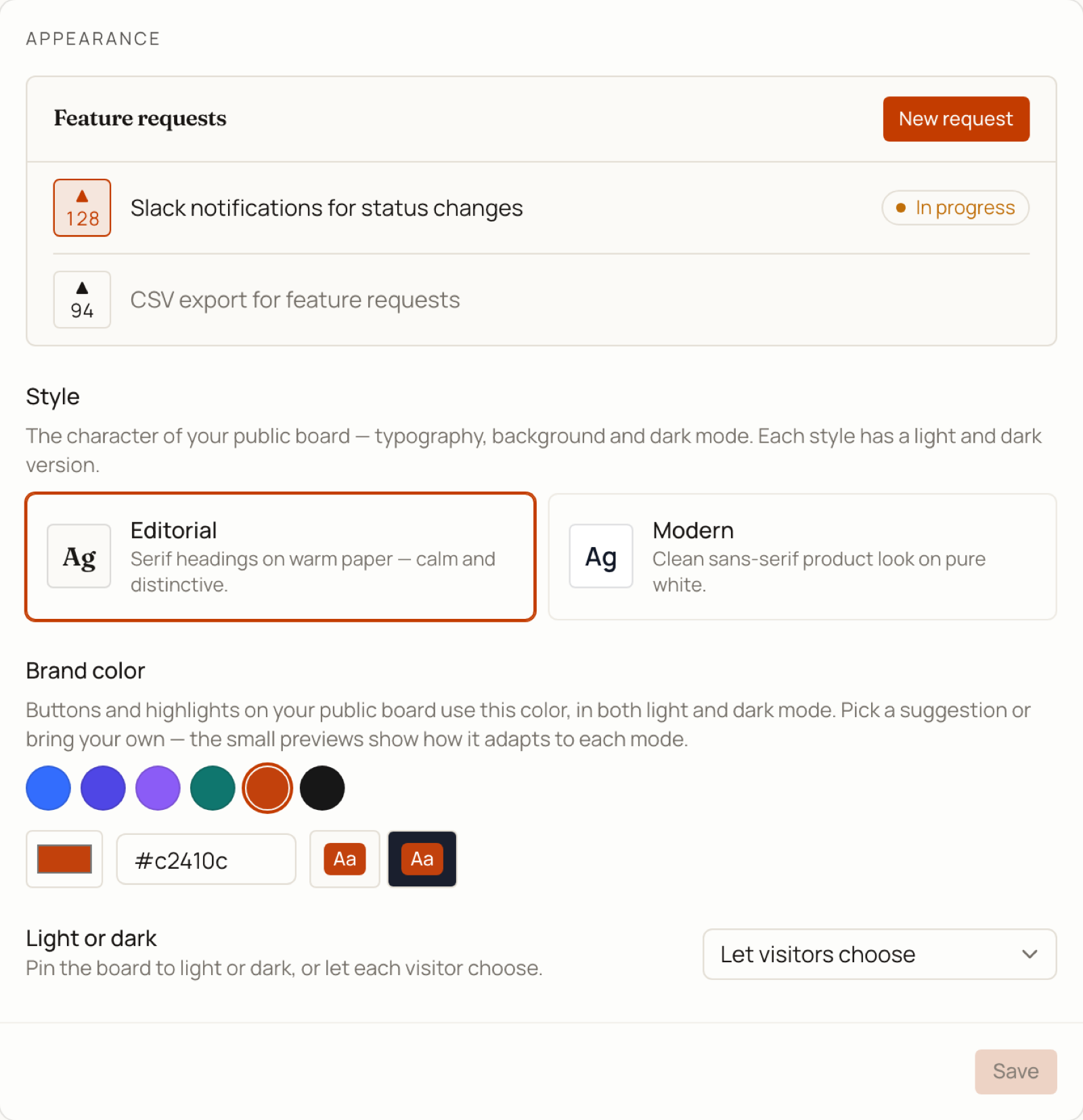
How your board looks is two separate choices: a style and a brand color. A live preview at the top of the card repaints as you change either one, so you see the result before you leave the page.
Style — the character of the board: typography, background, and how dark mode reads. Two to pick from, each with a light and a dark version:
- Editorial (the default) — serif headings on warm off-white paper. Calm and distinctive.
- Modern — clean sans-serif on pure white. The familiar product look.
Brand color — the color your board paints buttons, highlights and focus rings in, including a vote button once that visitor has voted. Click one of the suggested swatches, use the color picker, or type a hex value like
#4f46e5. FeatureVote works out a readable shade for light mode and a separate one for dark mode, so a color that only works on white still works on a dark board — the two Aa chips next to the field show both, on the real board backgrounds.Leave it alone and the board uses the style's own color (burnt orange for Editorial, blue for Modern). Once you've set a color, a Use style default button appears to put that back.
Light or dark — pin the board to Light or Dark, or let each visitor choose (follows their system preference).
If your board used Classic, Clean or Indigo: it looks exactly the same as before. Those three were the same sans-serif board with a different color, so they now show up as Modern with that color as your brand color. Nothing on your public board changed, and you can pick any other color from here.
Access
Visibility — who can reach your board. Four levels:
Public Unlisted Hidden Private Your users, through the embed yes yes yes no A stranger who has the link yes yes no no Google and other crawlers yes no no no Public is the default and the right choice for most boards — people find it, and it shows up in search. Unlisted keeps it off Google but open to anyone with the link. Hidden opens only for people arriving from your own site, which is what you want if your product is behind a login. Private turns the public board off entirely, leaving it to your team.
Access key — appears when you pick Hidden. Add it to your embed as
data-access-keyand it's the thing that lets your users through. Every snippet on the Install page already includes it. Regenerate issues a new one and stops the old one working within a few seconds — use it if a key gets out, then re-paste the new snippet.It hides the board page, not the data behind it, and anyone who can load your page can read the key in its source. See Hidden boards for the full setup.
Show team member names — when on, your team's real names appear on public comments and activity instead of "Team Member".
Require email to vote — off by default, so visitors vote in one click with nothing to fill in. Turn it on to ask for an email before a vote counts.
Require approval — when on, new requests from visitors are held as Pending Approval until your team reviews them, instead of appearing on the board immediately.
Access can also be tied to a Patreon campaign, which is set up on the Integrations tab rather than here. Patrons only limits voting, suggesting and commenting to active patrons, and can hide the board from everyone else. See Patreon.
Localization
Board language — the language your public board interface is displayed in. Pick a fixed language shown to every visitor, or Auto (visitor's browser) to follow each visitor's browser language. Available languages: English, Español, Français, Svenska.
Only the board interface is translated — your feature titles and descriptions stay in the language you wrote them in.
AI translations — lets visitors translate feature requests and comments into their own browser language using AI.
Feedback
- Issue reporting — lets visitors report bugs and issues privately from your public board. Submissions land in your Feedback Inbox.
Roadmap
- Show public roadmap — displays the Roadmap tab on your public board.
- Visible columns — choose which status columns appear on the public roadmap. Options are In Progress, Planned, Completed, Requested, and Declined. New boards show In Progress, Planned, and Completed by default.
See Using the Roadmap for how the roadmap works day to day.
Once your board looks the way you want, head to Install FeatureVote to put it in front of users.