Most feature voting tools have a free plan. Very few of them are free in a way that survives your first hundred users, which is exactly when you need the board most.
This is a comparison of what the free plans in this category actually include, and where each one stops. Disclosure: we make Featurevote, one of the tools compared here. Every price below was checked in August 2026 against the vendor's own pricing page, and each is linked so you can check it yourself.
What should a free feature voting plan include?
A free plan is useful when it can run a real board for real users, not when it is a timed demo. Four things decide that:
- Is the board public and unlimited to visitors? A cap on how many people can see or vote on your board is a cap on your feedback, not on your usage.
- Can people vote without creating an account? Sign-up is the single biggest drop-off in feedback collection. If voting needs a password, most of your users will not vote.
- Is it permanent, or a trial? A 14-day trial is not a free plan.
- What triggers the upgrade? Some tools meter the thing that grows on its own, so the bill arrives because you succeeded rather than because you asked for more.
How do the free plans compare?
| Tool | Free plan | What it caps | Cheapest paid |
|---|---|---|---|
| Featurevote | Permanent | 15 active items | $9/mo, billed yearly |
| Canny | Permanent | 25 tracked users | $79/mo, billed yearly |
| Featurebase | Permanent | 1 seat | $29/seat/mo, billed yearly |
| Frill | 14-day trial only | No permanent free plan | $25/mo |
| Feature Upvote | 30-day trial only | No permanent free plan | $49/board/mo |
Prices and limits checked August 2026 against each vendor's own pricing page. This category reprices often, so follow the links before you quote any of these.
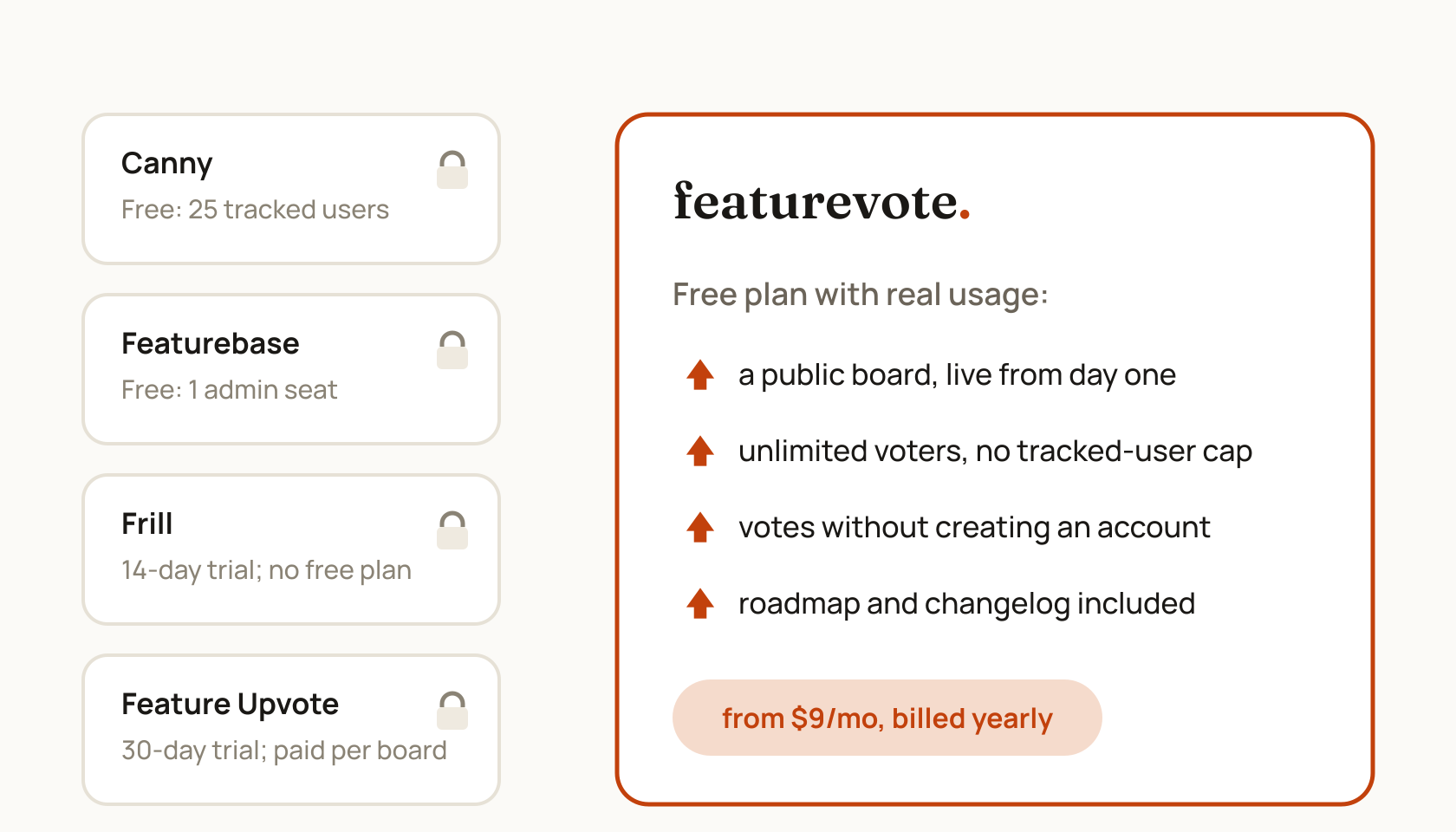
The pattern worth noticing is not who is cheapest. It is what each plan meters. A cap on active items is a cap on how much you are managing at once, and you control it by closing things you already decided. A cap on tracked users is mostly a cap on how well your product is doing. You have some control — Canny stops counting a user once their posts are closed and they have no other outstanding votes — but the lever is weaker, because the count also grows from feedback your own team logs on a customer's behalf.
Why does feedback need a board in the first place?
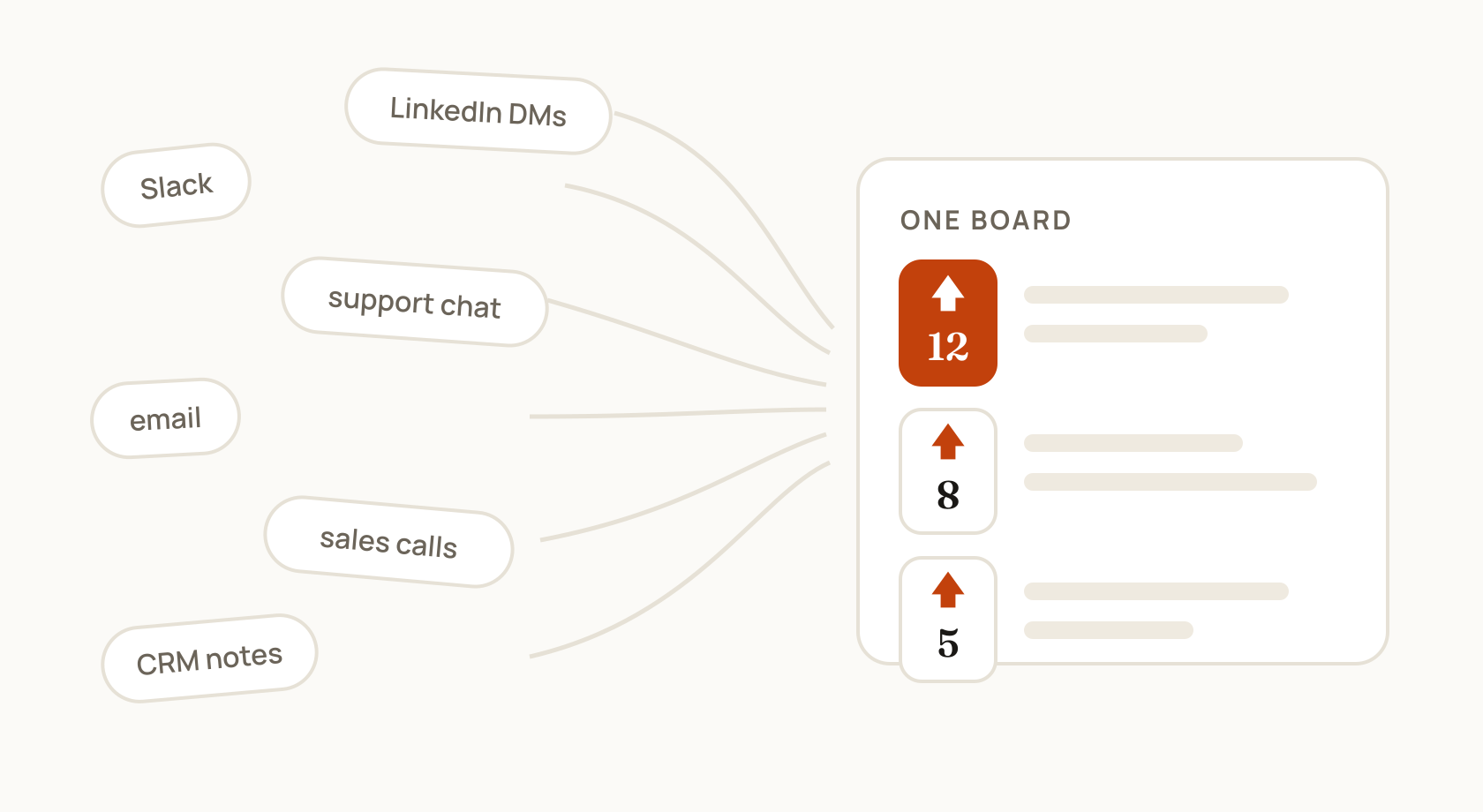
Because otherwise it lives in six places and none of them are countable.
Requests arrive through support chats, sales calls, CRM notes, LinkedIn messages and internal Slack threads. At roadmap time the context is gone and the decision falls to whoever argues hardest. That is not a prioritisation problem, it is a filing problem.
A public board fixes the filing: customers submit once, other people upvote instead of re-reporting, and demand becomes visible without anyone interpreting it.
What can you actually do on Featurevote's free plan?
Since this is our tool, here is the specific answer rather than a feature list.
Collect ideas without a sign-up wall. Users post and vote without creating an account. This is the single largest difference in how much feedback a board collects, and it is on the free plan.
See real demand. Votes and comments show which ideas have momentum. When someone submits, similar existing requests are surfaced to them first, so fewer duplicates get created — and the ones that slip through can be merged with their votes pooled rather than deleted.
Publish a roadmap and a changelog. The public roadmap and the changelog are both included, not held back for a paid tier. Turning requests into decisions is covered in more depth in turning feedback data into action.
The cap is 15 active items at a time. When a board outgrows that, Growth is $108 a year, which works out to $9 a month, and Pro is $348 a year. Both are flat: the price does not move when your user count does.
Which tool should you actually pick?
Honestly, it depends on the constraint you are under:
- You want the most requests on a free plan. Featurebase, honestly — its free plan documents unlimited feedback items and unlimited end users, where ours caps at 15 active items. The trade is that it gives you one admin seat.
- You want a free board your whole team can administer, with account-free voting on by default. Featurevote's free plan: no seat cap, no cap on who can see or vote, and the roadmap and changelog included.
- You need deep integrations with an existing enterprise stack. Canny and Featurebase both go further here than we do.
- You want a trial to evaluate against a specific deadline, not a permanent free tier. Frill or Feature Upvote.
If you are choosing mainly on how the bill behaves later, the Canny alternative walkthrough goes through the scaling models in detail.
Frequently asked questions
Is a free feature voting tool good enough for a real product?
Yes, up to a point — but which point depends entirely on what the plan meters, and the four plans above meter four different things. Featurevote caps active requests, so the ceiling is how much you are managing at once. Canny caps tracked users and Featurebase caps admin seats, so their ceilings move with your product and your team. Free plans rarely fail on missing features; they fail when the thing being counted is the thing you cannot stop growing.
Can users vote without creating an account?
On Featurevote, yes, on every plan including the free one. Several of the tools above support account-free voting too — Featurebase, Frill and Feature Upvote all document some form of it — so the thing to check is not whether a tool can do it but whether it is available on the plan you would actually be on, and whether it is on by default. It matters more than it sounds: every step between “I wish it did X” and a recorded vote loses you a share of the feedback.
What happens when I hit the free plan limit?
On Featurevote you close or complete items to free up slots, or upgrade. Nothing is deleted and the board stays public either way.
Do I need a credit card to start?
No, and you should be suspicious of any free plan that asks for one.
Will the price change as we grow?
Not on a flat plan. That is the whole argument for one: per-user and per-tracked-user pricing means the tool gets more expensive precisely when your product is working.